
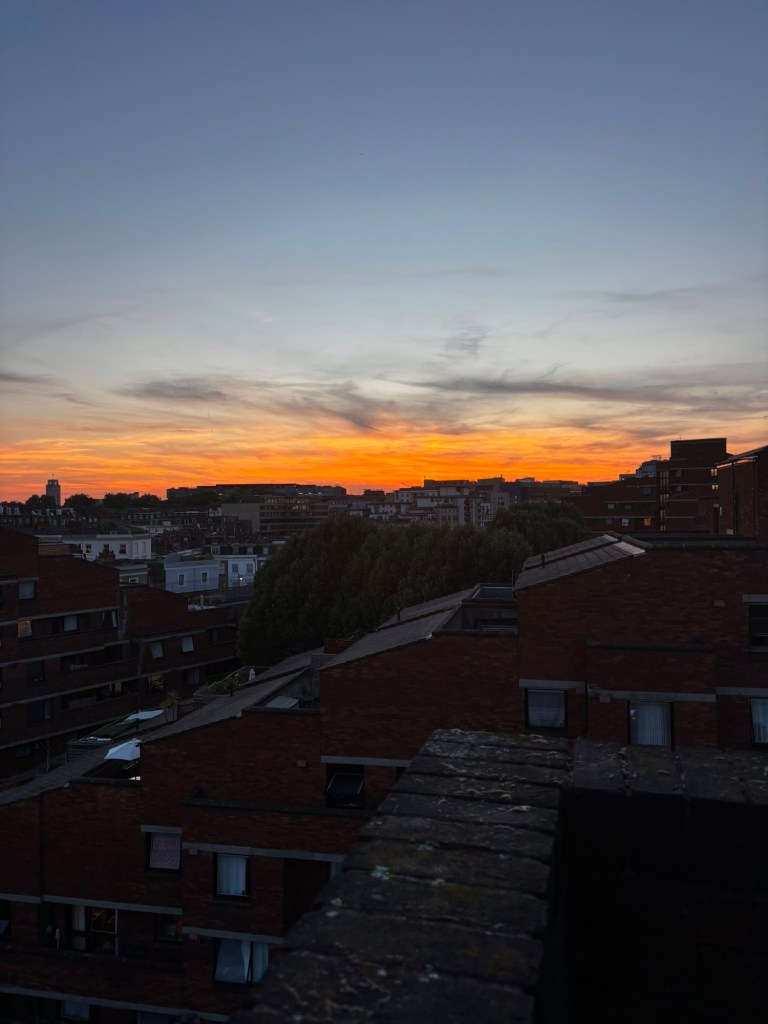
Her stomach is swollen with Sunday lunch. It is the weather for mellow music, hairy pot bellies, and barbeques. I picture Birkenstocks and black-haired toes, grass the colour of sand and the Black Eyed Peas on the radio. I eat pomegranate seeds out of a little tub, and sit topless on my balcony in a new pair of frilled lace white shorts which cost me more than I’ve spent on trousers in a year. When she saw them, my sister said she could have made them for free. I think idly about consumerism, and watch last night’s wine glasses drip dry in the midday sun, condensation crawling up them like a shattered chandelier. Unable to pause, I arrived in London for one night in the entirety of August and immediately invited friends round to dinner, stirring too-strong garlic and foul-smelling blotched purple onion into buckwheat tabbouleh and plopping M&S cooked chicken and feta onto a plate. It feels unceremonious, entirely natural. It was is the best dinner I have had for a while – four friends, an uneaten courgette, a sunburnt chest and conversation — all the usual conversation of men, women (read girls, boys) in their early twenties: sex (lack thereof); money (lack thereof); jobs (lack thereof); pleasure (abundant). The world glowed red, orange, the sky bleeding tomato salad and marjoram. We reference mental health like it was an exam period and physical ailments like we are all on the brink of death. We talk about marriage like it’s an aspiration, and the Married like they are mad. We talk about familial abuse, mental stains dripping dark mulberry juice which pools in the creases of the life lines in our palms. We are brothers and sisters, but we never argue like it. It is the first time I have heard the words from his lips. We belong to each other. He turns to look at the sunset, snapping a picture (“I’m an Instagram Warrior”): sometimes you’ve got to learn to keep the friendships you want in your life forever, and leave the line in the sand clean and uncrossed. It’s like Cricket. Just stay inside the box.
I text my cousin in Paris said I can’t wait to join her. I send her a follow-up text – I don’t think I’ve ever meant can’t wait more literally.
I take my new hair to lunch after I’ve swished it up the Strand. Taking oneself to lunch is an intimate process. One reveals one’s preferences without fear of conflict or shame, exposing salad leaves in teeth and splashing water on the table without a hint of shame. I sit at lunch; I am already aware of the foibles of the girl within me, of her faults, of the fact that she is trying to finish her lunch (eat with her mouth closed, press a white linen napkin to her tingling plump lips, swill water over her tongue to cool the raging chilli) while the rest of her mind is busy, entirely occupied with the minute focus of a small child studying a worm with the splot of tomato stain which landed on her knee about five minutes ago. I admire her ability to continue polite conversation while her mind is thus preoccupied; I watch as she asks a probing question – such as do you believe you can be in love with two people at once? – flashes a look into the eyes of her dining partner (short look, quick heartbeat, slow under-the-eyelash-turn away to avert the gaze in a way which lingers, opening doors of conversation rather than leaving them closed) and meditatively dips the corner of her white linen napkin into her half-full glass of water. The white linen napkin is folded around her forefinger; she swirls once, then moves it slowly to her knee, where I watch as she dabs at the tomato stain, turning it from scarlet to maroon to puce to pink like some reverse-healing infected scar. She looks up again; places the white linen napkin (its corner softly stained, a light orange like the centre of unripe apricot) on the tablecloth beside her. Do you think Christians are polyamorous if they love their partner and God?
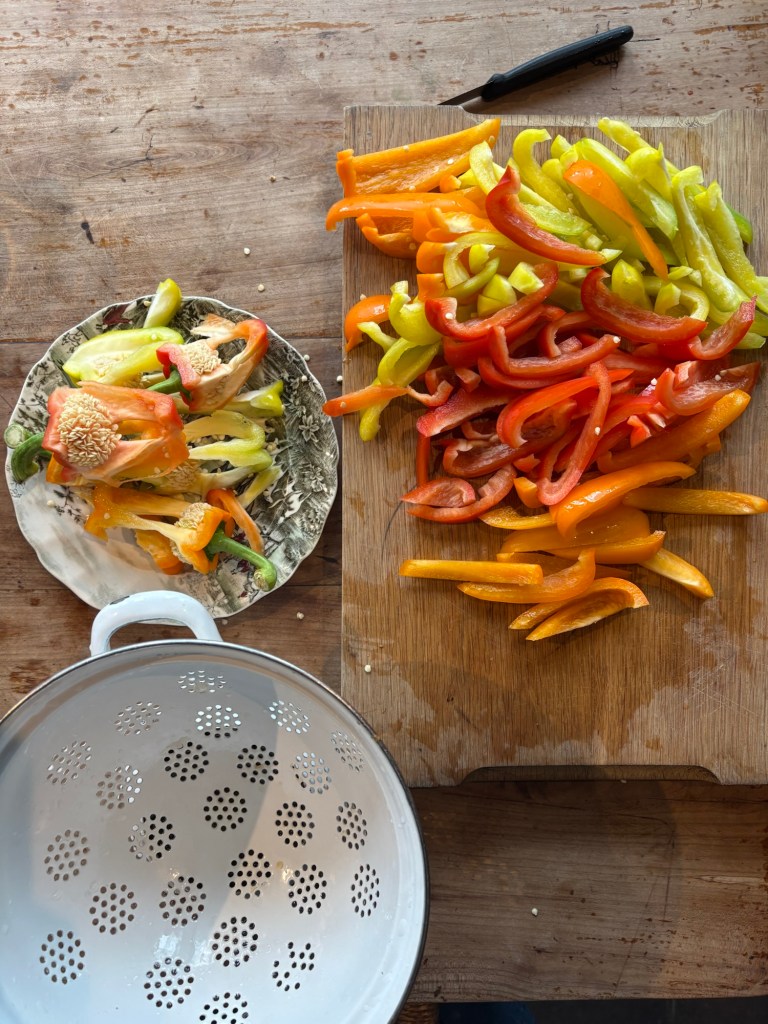
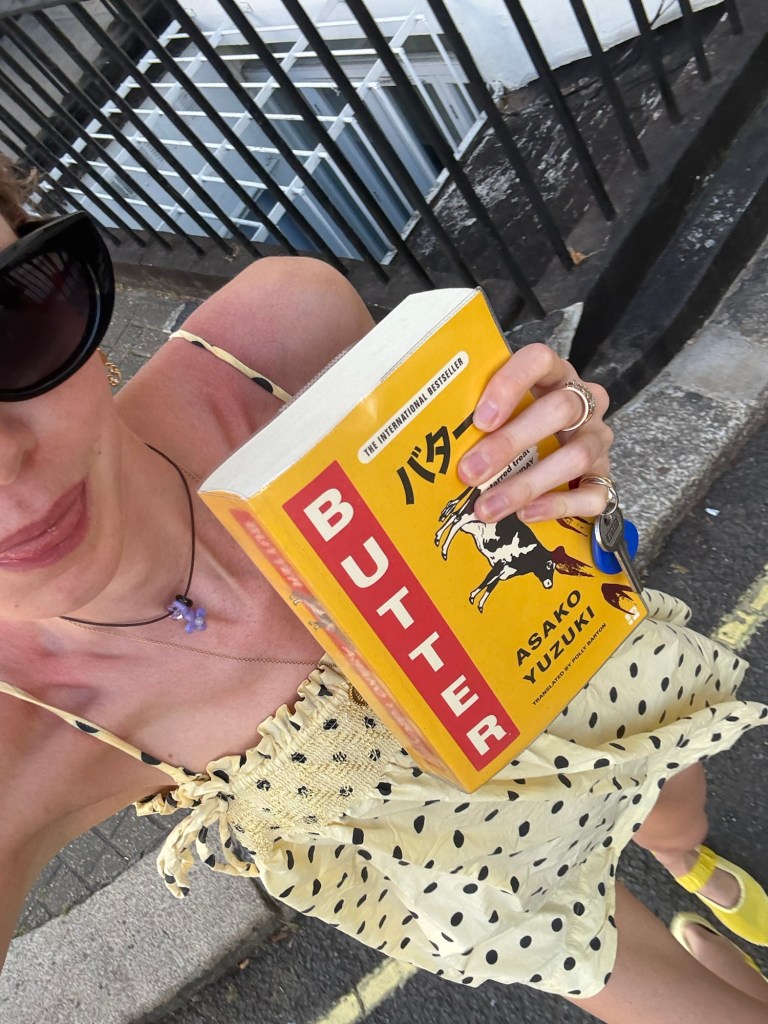
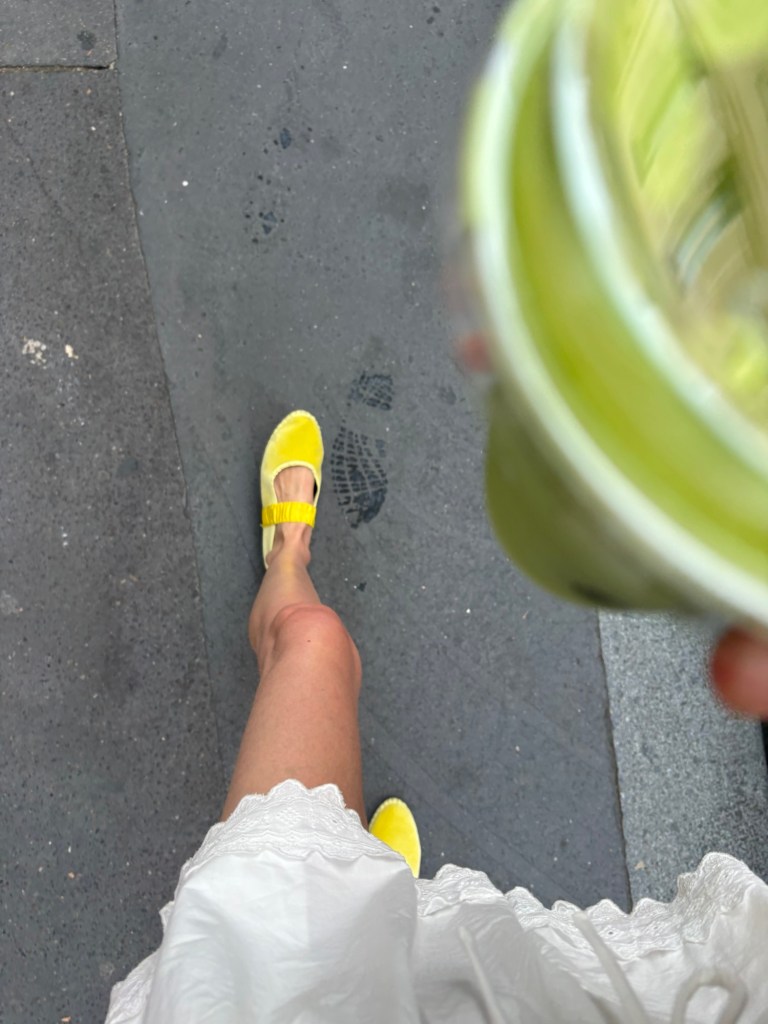
The train is so hot that I travel to London as a thought-less collection of pulse and cells. Podcasts play in my ears and I am involved the drama of 1950s Neapolitan Italy, in someone else’s friendship failures and someone else’s slurred vision of themself. I get off the train at Marylebone and studiously avoid catching the eye of my former music teacher with whom I have no desire to chat; I collect ‘Butter’ from the library, and take a picture of myself in a bright yellow dress and bright yellow espadrilles clasping the bright yellow front cover to my red prickly-hot chest: in my head, the caption reads When Even the Book is Butter. I run home, put the music on the speaker, open the French doors. I boil the kettle for the tabbouleh, and place the sliced tomatoes on the table under a tepid stream of liquorice coloured balsamic vinegar which sticks to my fingers in a sweet smelling glue. ABBA comes on: Our Last Summer. I sway my hips in the kitchen, and recall it.
I am the kind of excited, which means I can’t sleep. How could one sleep a single second in the city of Ratatouille and Venus, Emily and Chartier? I am like a water trough with the valve constantly compressed, or – more aptly in France – like there is a plastic tubular spout of carbonated water fizzing IV-like directly into my veins. My yellow espadrilles chant on the London street: Pa-ris, Pa-ris. Billy Joel was wrong: Vienna’s somewhere, but it’s Paris that waits for you.
In Marylebone, I watch two ladies. She’s split coffee down her top, and she’s wearing a bright yellow linen blouse. She marches across the road, pretending to ignore the coffee seeping through her cheesecloth shirt. She flings her foot onto the gummed-up lid of the bin and re-ties her shoe lace. This is womanhood in the city, August-style.
Cold Courgettes Call me Home.
I sit down on the train. My supper is in my lime green bag and my stomach is lined with excitement. I feel as though I am about to get seriously drunk. I think about the times I have boarded this train, travelled this journey before. Outbound, alone: Valentine’s Day 2019, with pit-of-the-stomach nerves. I am 16. I am visiting my French exchange, whom I have known since I was 11 and love like a toddler loves her babysitter. She is an aspiration, wholly glamorous and entirely other. She could not seem more foreign to me, nor more similar. I gurgle at her, and we communicate in this way, me looking up to her for her beauty, her red lipstick, her dark eyes. We meet her sister and head straight to a bar. I drink my first cocktail, Tequila Sunrise, in Paris, and think it is sick-sweet-delicious and I want more, more, more. 16 feels liberating cusping on sensual, accentuated by miscommunication and total knowledge of how to have fun. We go into my first nightclub, and leave immediately because it pulses with the bodies of fat men in sweat-socked navy blue polo shirts. They ooze from the club like a grotesque, unwanted zit. We collapse into a taxi, and revert to Truth or Dare. I reveal my only secret, which I have held hang-man style, a dead-weight in my heart for two years; secrets are easier to tell in French. Inbound, as a pair: January 2023, eating rillette stuffed baguettes with soggy rocket leaves spilling into the brown paper boulangerie bags. I had prepared them because I wanted to mother him, because it was my way of showing my love, because he had whispered under his breath how much he needed me and because he had taken me to Paris. I had made them because I was 19, and because I saw him as the rest of my life. Paris was to me a city of discovered desire and undiscovered, undiscoverable love. Love eluded me. It eluded Paris. She painted sex on her face like make-up and covered the veins of love with foundation on her beauty-spotted skin. (French women don’t wear foundation; they, nod only they, must have the secret to love). We had a conversation in the Metro, in the swirling hot air which rushes and recedes, rushes and recedes – the only steam of heat in Paris in late January, when even furs feel too cold and your nose turns pink in the frost – in which he told me about his future. It felt illicit. And it did not feel like mine. I felt it; that twinge, that niggling doubt, that drip of black coffee down the porcelain cup which wears it down, down, down until it cracks along that same line a year later. He felt like a stranger to me, and I giggled and took his picture as he emerged naked from the shower. I was hot and freezing and jaded and new. I was not in his future. I was constantly at odds with his past. I was a comparison and a lost cause, a fill-in-the-blank and an easy out. I made him rillette sandwiches. Exactly one year later, he broke my heart.
I felt that twinge for the very first time on the Metro on the way back from the Eiffel Tower. I felt it. This wasn’t it. Something was wrong. We didn’t want the same things from life. I didn’t feel loved, but I felt necessary. Something he could use sometimes. The accessory his life had been lacking. An external part of him; a spare tyre. He consumed me. He was all of me. I wanted, too desperately, to be all of him. I went to his student room one afternoon when I couldn’t find him, when, as usual, he hadn’t replied to his texts for hours. We were meant to be meeting up, but timings never seemed to affect him. I opened the door, smelt the now familiar husk of un-laundered shirt, late adolescent male, sharp cologne and sweating bike shoes. I walked to his desk, ignoring the posters on his wall of women I didn’t like looking at when lying in his bed. I read a letter from his mother. She cared too much (can mothers care too much?). She had written, at the very bottom, just before she signed off (all my love): always do the right thing. I reread the line. It seemed so out of place. I thought it must be coded. It seemed to me completely laughable that the line could ever apply to her son. He never did the right thing. It just didn’t occur to him to do the right thing. The right thing wasn’t in his vocabulary. Did she know this, or was she so blissfully ignorant of her son’s character flaws that her maternal encouragement was in fact an ironic display of her mis-placed obsession? I smirked, dropped the letter, threw a two-fingers-up glance at the women in the posters and left. He wasn’t there anyway. He was probably out somewhere, doing the Right Thing by someone else. I don’t miss that smell of bike shoes and cologne and stale sour sweat. I don’t miss the women on the walls or the crumpled paper in the un-emptied bin. I don’t miss the university room, the carpet in the corridor which had never been deep-cleaned, the toastie maker in the kitchen or the mouldy pesto in the fridge. I shut the door. For once, it was me who left.
She is not wearing any shoes in St Pancras station and I believe it is a crime against humanity. They are loading us slowly, like cattle to market, slashing us with bending bamboo poles across our rumps. I buy an M&S bean wrap and chat to the man at checkout. He is not English, so we speak in monosyllables. Where are you going? Paris. Family? My cousin. How long? Too short.
I place her at three. She has tight dusky blonde curls which hang in greasy ringlets down to the shoulders of her pink t-shirt. She wears crocs with badges studding the plastic which covers her toes. She uses both arms to throw her new Build-a-Bear bunny (who wears a red sweatshirt with L-O-N-D-O-N across its front) high into the tray at security, holding him behind her head and sticking out her tongue before launching him with so much of her tiny little might that she lifts herself too, jumping in the air as he lands, smack-bang (thump), in the centre of the tray. Her father is distracted by the ordeal of moving two little girls and a push chair through international security, so I give her a winning smile in recognition of her Great Work. She waves her bunny off, runs through the security gate, and presses both hands against the rim of the roving suitcase trolley. In her eyes are all the excitements of her holiday, all the thrill of travel: she is waiting, expectant, for the gloom of the suitcase tunnel to birth her bunny. She does not move. Her hands are turning white with the pressure. She grows tired of waiting and, never moving her eyes from the gaping womb of the security gate, allows her fingers to run idly over the moving wheels. Her father pulls her away – stop that: your fingers! Before she can argue, her bunny is born again.
I swirl a nighttime berry tea into takeaway Pret coffee mug and marvel at myself. I would never before have had the confidence to ask for a mug of boiling water, without buying a single thing. The man was young, Indian, kind. He smiled at me, wrapped the mug in a protective cardboard jacket, and handed me my boiling water. Have a nice holiday, he said. I text my friend #iamastrongindepenantyoungwomanafterall about something completely unrelated. I feel strong. I feel oddly powerful. I feel confident. I am becoming the inconnue again. I am a writer. I travel alone.
I hear the whistle blow and I smile. I slurp the dregs of my tea, and have the usual fumble with the man next to me as we simultaneously stick our charging plugs into sockets we both know will never work. We roll our eyes at the ‘Free Train WiFi’. He drinks Vimto blackcurrent and is perhaps the only person I have ever met to do so.
The train smells like salt and vinegar crisps. I do a wordsearch, watch as another Eurostar draws into St Pancras, feel twinges of sorrow for the people on board whose backs are to Paris when my nose is faced that way. They going the wrong way. Someone should tell them so. I tug open the wrapper on my supper, and dig in my bag for chocolate.
Muma, are we in the water now? (London stretches outside the window, hot in the evening sun). Are we flying? More crisps! Muma, are you thirty-four? Muma, Muma — how did Michael Jackson die?
I watch from the train as we speed through France, hunting down Paris like a bloodhound. People have picnic chairs lining the charred sweetcorn roadsides, pointing towards the sun: from the train I cannot see it, so I see it through their eyes. Solar eclipse, our world on an axis.
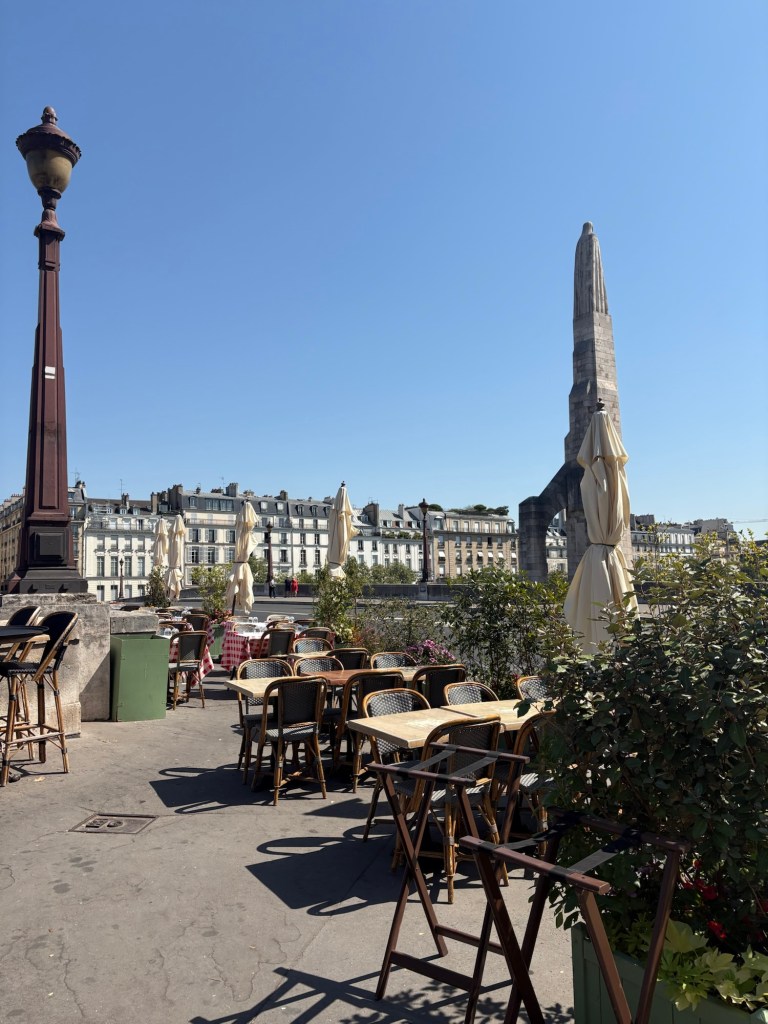
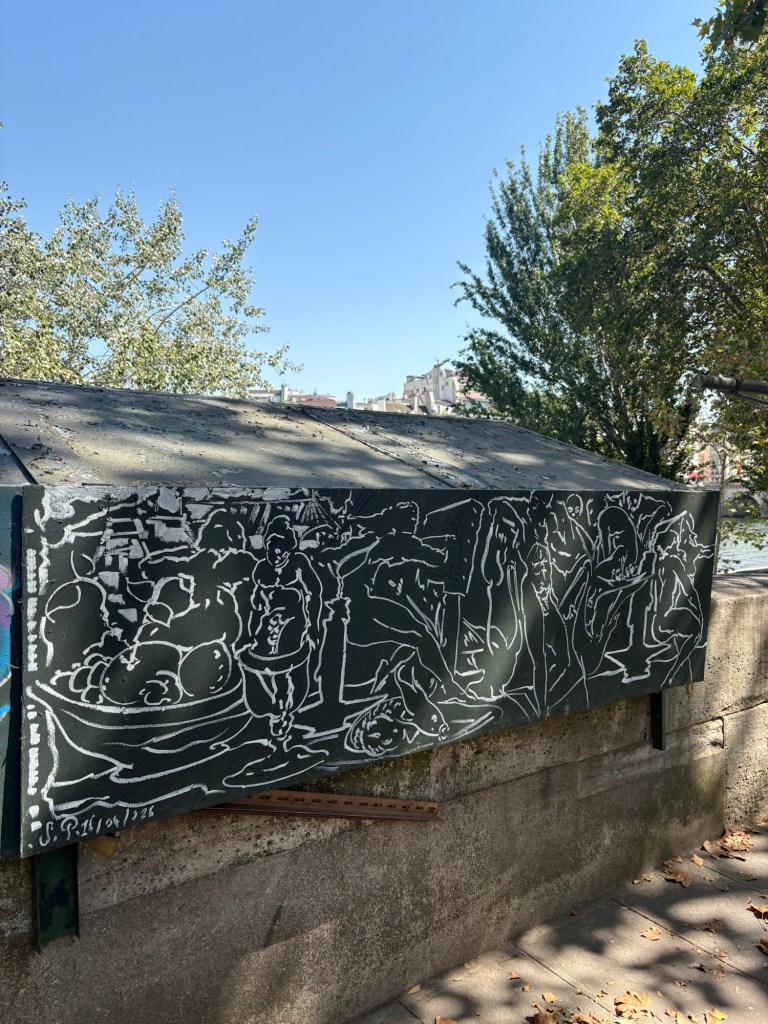
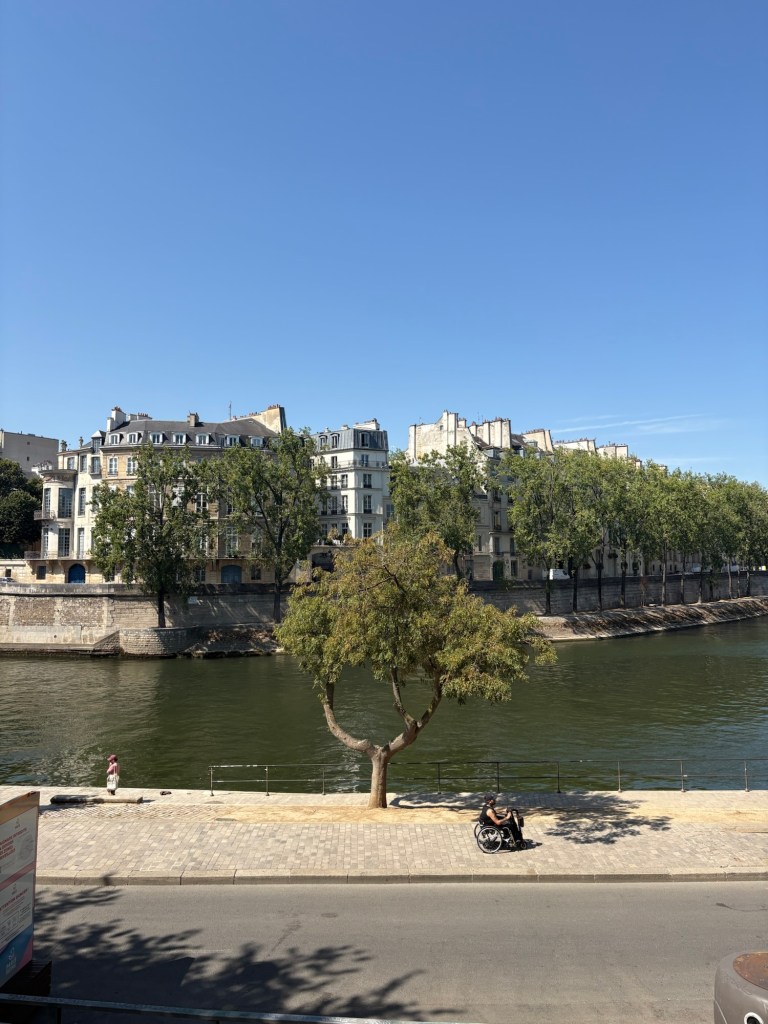
La Rentrée
There is a space shaped like the Eiffel Tower, and it is a hole in my heart. I have bled through it with skyward, pointing tears, since I left last March. She runs down the street, white skirt, glasses which suit her but which I haven’t seen before. We hug. Embrace. You are in Paris.
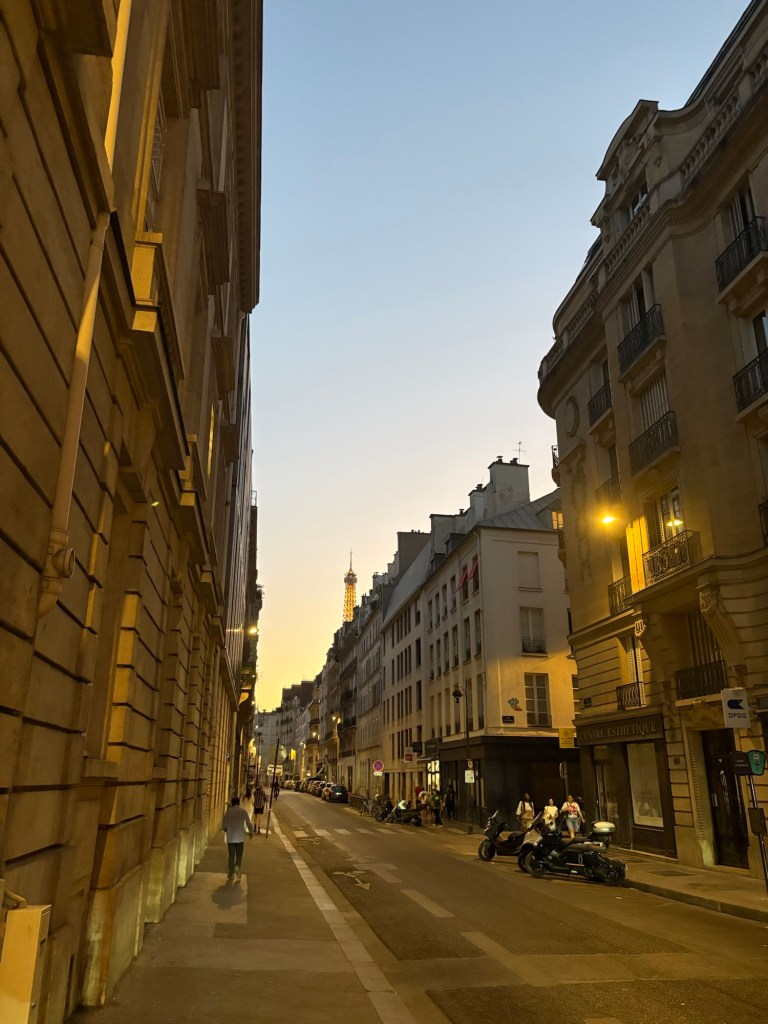
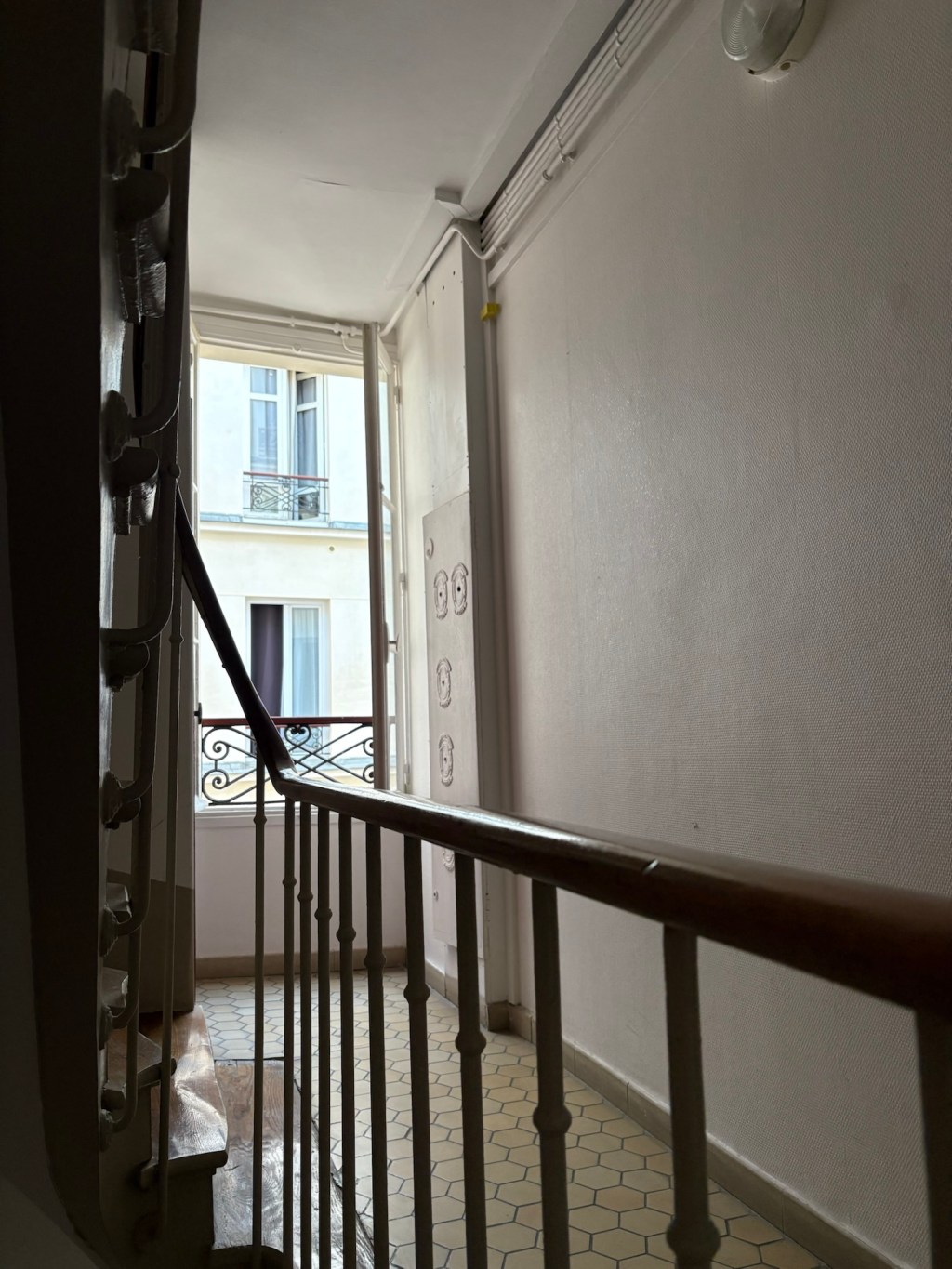
It’s like I never left. The intervening months of my life never happened. They are like a baby’s sneeze, or the little burps after too much milk. They didn’t exist. How could anything exist except this? I opened her front door and smelt the corridor: cigarette smoke. I called back to her that I felt at home. She made some joke about her new bad habits, and I left, walking slowly up the corridor to drink, truly drink, like a camel (Camel cigarettes), like an elephant, like a damned thirsty pilgrim, this smell into my bones. It seeps gently into the skin, yellowing and staining. Nicotine rims all my photographs of Paris, my addiction, the satiation of my claustrophobic desire. My bad habit. (The stairwell is cool, the window open; outside, Paris). I smell the cigarettes, and it smells like home. I emerge into the street. It’s seven minutes to eight in the morning, and I look at the morning sunlight dancing on the limestone buildings. Heat engulfs me, like a vacuum. I am grinning, and the bin man looks at me like I am a fool. I return to my old road, look up to the balcony window which has remained my screensaver through all the injustices of the past year. I remember the beggars. I remember the disabled man who travels everywhere by bike. I remember the place they served me whiskey, and the truffled cannelloni I ate alone. I wait in line for my matcha, and idly wonder why the barista is so good looking. I have overspent, so I wait for the thick coconut cream to hit my tongue, to soak it in, to find something, somehow, to satiate my desperate thirst. The bin man looks like Charles Leclerc.
You can be an artist here because, frankly, there’s nothing else to be. Great things are expected of you in France, you can see it right down to their food. Something comes from nothing. Care is taken for the tiny. There is a pride of being, a sense of security in self which makes their endless failures in battle a continual puzzle. The Frenchman is sure of what he stands for; he cannot be argued with. He is an arist. He sets up his easel in the Palais Royale in the golden morning of pure sunshine which follows an eclipse. His easel is a board, over his knees, a sheet, stripped straight from his bed, a large stretch of canvas. He is wearing suede loafers in light fawn, cream chinos and a blue cotton shirt. Occasionally, he stands, stretches his palm down the avenue of trees, and looks. I watch him looking. I watch the light cracks between his fingers and the pencil marks up his forearms. I watch his eyes squinting at the distance and I watch the sunshine crowning the bald top of his head. I am a writer. I pull off my shoes and place my blue toenails on the cool stone rim of the fountain. The sun is hot, and it is not yet 10am. I can feel my chest prickling in appreciation, my stomach satisfied and curling with green cream, my eyes chasing returning swallows over the chimney tops.
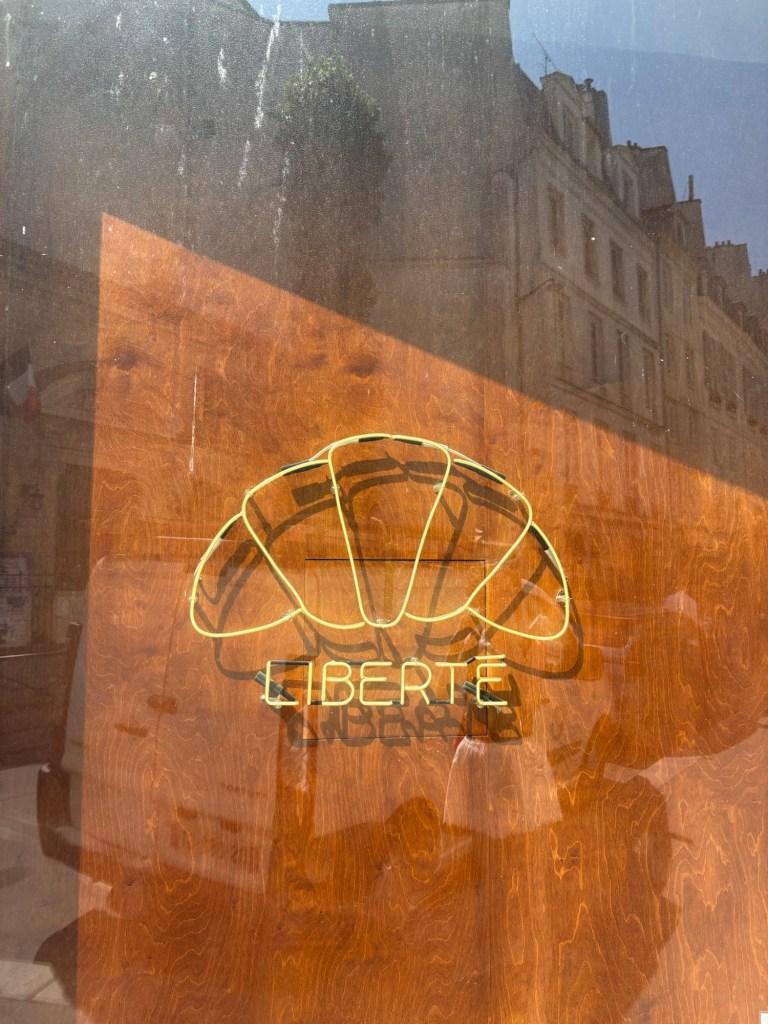
I am a writer. But currently I am all croissant. Nothing exists, there is no part of me which is not engulfing the pulsing, living, globule of pistachio butter which swells in my mouth, presses out between my lips, filling the space entirely between the neck of my tongue and the plaque of my teeth. It is all of me. Consuming.
In the slanting sunlight of Haussmann buildings and designer black shades he could be young or old. 18 or 46. His age is irrelevant. I cannot see him against the sun, and I wonder whether we can ever truly see artists work. He is an artist; he sketches. He glances at me as I walk by. A small smile. A distraction. My phone is sticky with pistachios.
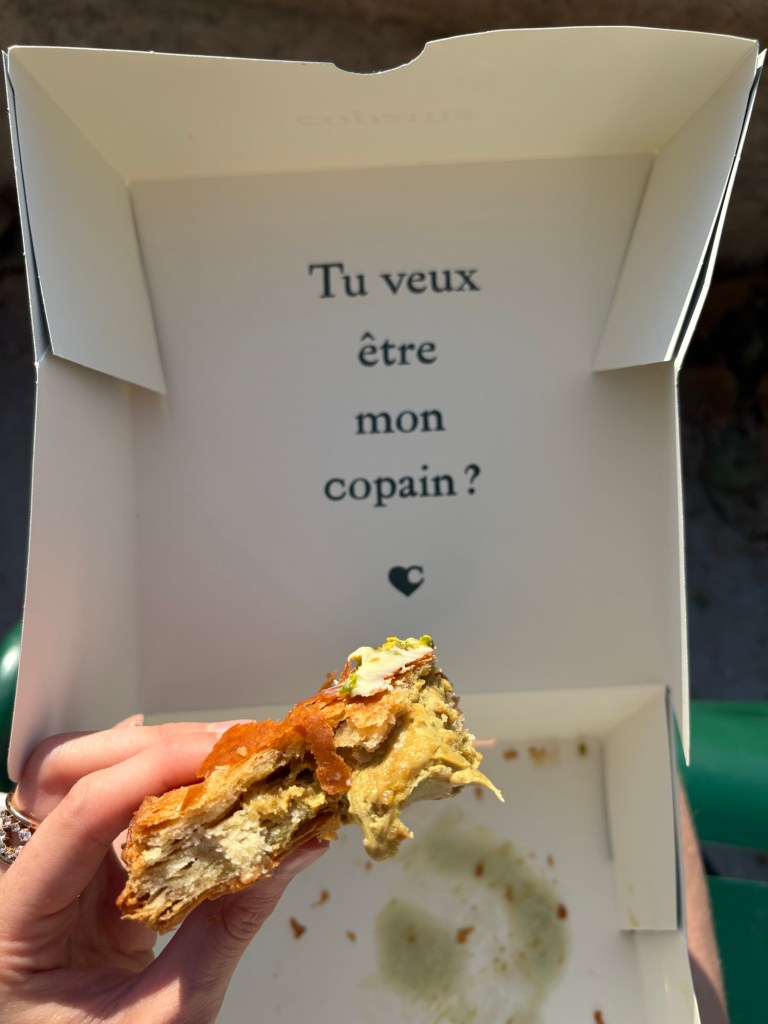
I have died and gone to heaven and I have flakes of croissant stuck to my leg. Everyone dresses better (I, too, have better clothes). The man I fell in love with in the bakery last year is still the same boy, with an earring and golden blonde curls. (I avoid him; my love made me over-pay for a not-too-good pastry). They wear red ballet flats and black capris, short flower-patch dresses which look as though they have come straight out of the new summer collection from Ba&sh. They pose in wedding dresses by Japanese designers and have their trench coats corrected as they stand in a fountain. The fashion is felt and unspoken, either a blessing you are bestowed with or a curse you spend time and money attempting to expel. The conversations are detailed, if not serious. The green metal garden chairs are pulled at an angle to one another, so that her rucked-up knees fold directly above his outstretched feet. His espadrilles are the same colour as the dust. They have been performing this art – this dance, this romance – for an hour. Their noise has not stopped, the shouts of their conversation cutting through the running fountain and causing the morning readers to look sharply their way. They do not notice. I smile for the — they are so enraptured. I cannot tell if they are in love, or simply so desperate to discover every corner of the other’s being, every shadow behind each doorframe, every toothpaste stain on each counter-top, that being in love on top of that would be superfluous. Can you know, must one know, every intricacy of one’s lover? Doesn’t love breed strangeness, cast flickers of hidden flames like shadows on flagstone floors behind the iris of the eye? To love as these two talk would be exhausting. Every inch of them is entangled, and their limbs stay resolutely apart. I believe this love is called friendship. I admire it.
He eats a banana graphically then drops his Perrier bottle with a clatter on the ground. I cover a smirk, and do the same.
He has a dog. He drinks matcha. He reads. He wears blue linen shirts. I want nothing more. I walk past twice, hoping he’ll notice me. He doesn’t.
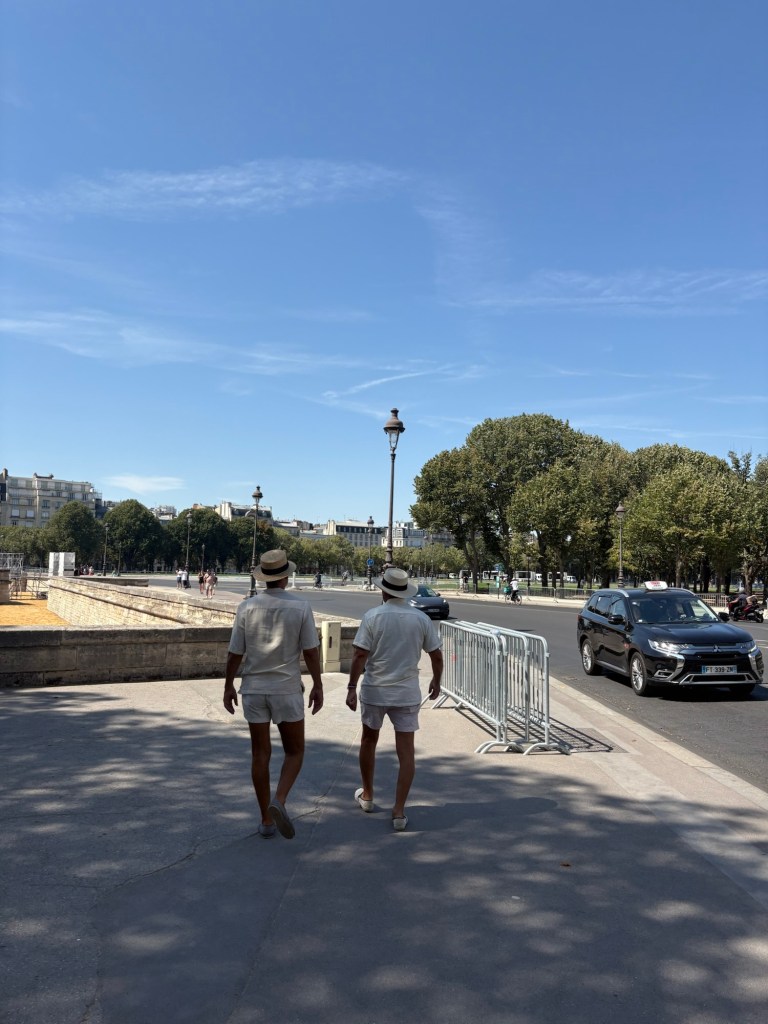
He is tall and self-conscious and wears white trainers and pale shorts. I like it when he touches his hair as I walk past outside the Invalides: I think he is doing it for me.
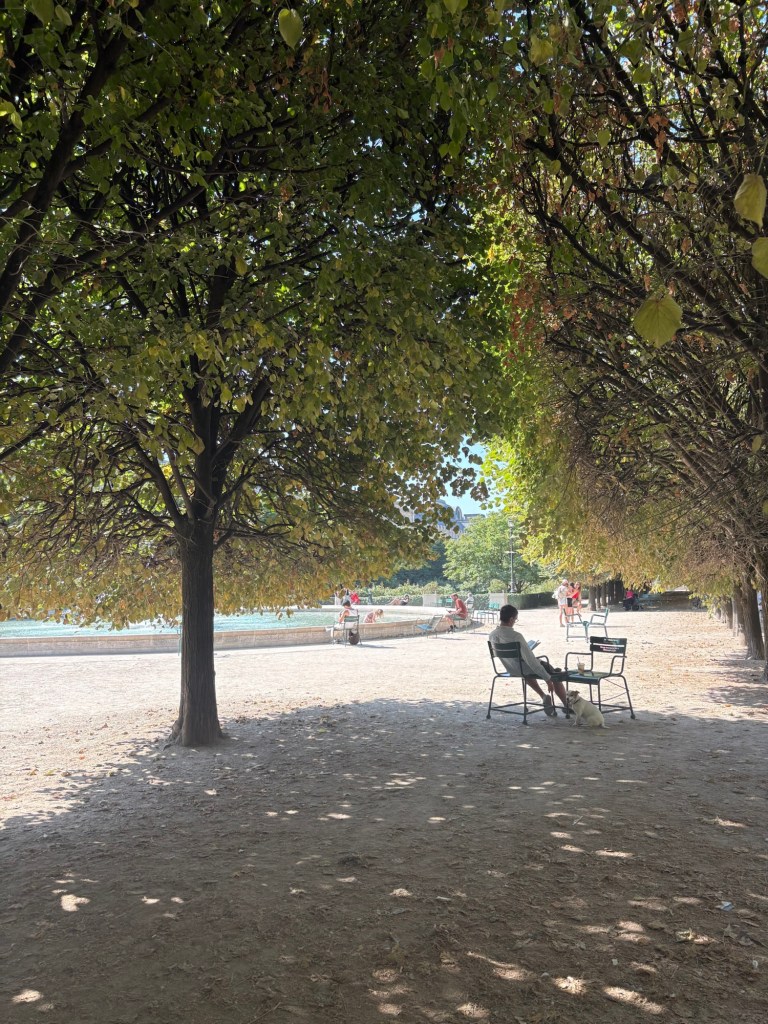
Madame no longer feels incongruous.
I am visiting a lover with whom I never broke up. We spend hours in bed reminding ourselves of each others bodies. I visit the freckle and the scar, the soft-touch behind the ear and the hot coffee breath down the spine of the neck. It tingles.
Total strangers wish each other a good lunch in the street. They are eating cardboard brown bread sandwiches with thin films of fake cheese and too-pink ham on a bench. They have Notre Dame as their view. I consider there to be worse things. I buy cold soup and bread studded with dates and return to the Palais Royale for lunch. I sit on a bench on the opposite side to a man and his mistress (too many lunchtime kisses, to obvious a parting of ways; she was twenty years his junior, generously). The man beside me apologises for raising his voice as he tucks his iPhone into the pocket of his suit. He is an Economist from Senegal. We talk. He tells me things I had forgotten people say in real life; they only seem to say in in Paris. He spoke in aspirational quotes and he spoke in French, and perhaps that glamorised it all the more. He wears a red and brown striped t-shirt and brogues, smart suit trousers and black glasses. He spoke to me kindly, slowly, with a hint of the Senegalese accent he has been ridding himself of for 25 years. I say I love the sun and he holds up his black arms and laughs that he has an advantage. I wave my white ones, and say I don’t. You have to follow your heart and there’s nothing stopping you. Every langue has a culture behind it. It is the humanist approach. Write everything down. It reaches seven minutes to two and Abdoulain leaves. I get my phone out, start writing. His father was in the Senegalese army. He has three daughters. An actress, a civil servant. He is kind. He says again that you have to do what makes you happy. I am happy I sat on this bench for my lunch.
When I start walking again, my feet are tired, and I realise I’ve probably gone too far. How could you ever leave this place? I love it with my body, viscerally, in my gut and in my nose. I love it hard, flexibly, in my earlobe and my little toe. I love it like it is the tripe lining my stomach, upturned on the table in front of me, single candle dripping wax on the Bistro-striped cloth. (A man eats French onion soup with his Papillon on his knee. The cheese has congealed around the rim of the bowl, and is perspiring grease into the liquid remnants of the Frenchman’s lunch). I go back to my cousin’s flat and turn the shower on full and cold. She has cherry soap which drags purple stains over my throbbing body. I spritz myself with her perfume, once, behind my ear, and sit naked in front of the fan.
I write. I will meet her for dinner. I am in Paris.
 Blue Dress
Leave a comment